Diacetyl is one of the trickiest off-flavors for brewers to deal with. Often lurking just below the flavor threshold, it can subtly dull the finest hop character. Or worse, diacetyl is sensorially undetectable in brewery-fresh beer but pops up after packaging due to the diacetyl precursor, α-acetolactate, converting into diacetyl after the beer has left the brewery. Brewers traditionally rely on several days of diacetyl rest or on the addition of purified α-acetolactate decarboxylase (ALDC) to speed up the process. We originally created FRESH™ strains—where ALDC expression is built into the yeast—thinking that having yeast produce the ALDC would be a more robust solution to the problem. And it is! Over several years of brewers putting it to the test, we’ve seen hundreds of happy customers, dozens of medals, and thousands of barrels of diacetyl-free beer. However, what we didn’t know is how yeast-derived ALDC compares to purified ALDC enzyme in various environments that are most relevant for modern commercial brewing.
To test how different yeast and ALDC treatments would impact diacetyl levels, we designed a recipe that we knew would result in high diacetyl after dry hopping. The beer was formulated with 15% maltodextrin and dry-hopped with a varietal known for its high diastatic potential. The combination of maltodextrin and diastatic activity drives significant hop creep. (Hop creep is the phenomenon where the enzymes from hops release more fermentable sugars from the dextrins in wort, and the yeast perform a secondary fermentation, which results in the production of α-acetolactate—the precursor to diacetyl). For more on hop creep, see this paper.
In other words, this experimental setup was optimized to test the effectiveness of different strategies for reducing diacetyl potential.
Experimental Conditions
- Chico yeast with no ALDC added.
- Chico yeast with purified ALDC added at knockout.
- Chico yeast with purified ALDC added at dry hop.
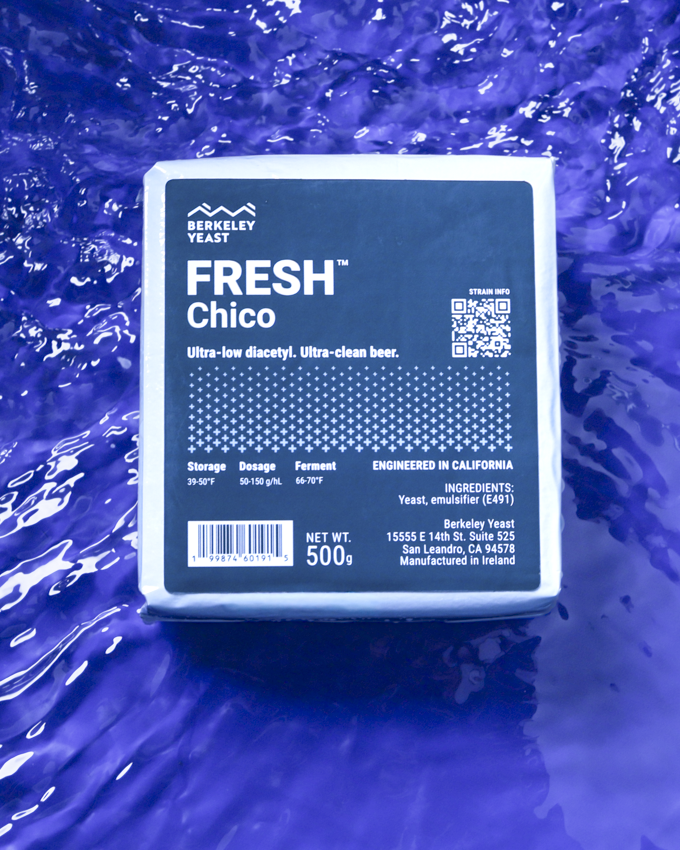
- FRESH™ Chico yeast, which has ALDC expression built into the yeast itself.
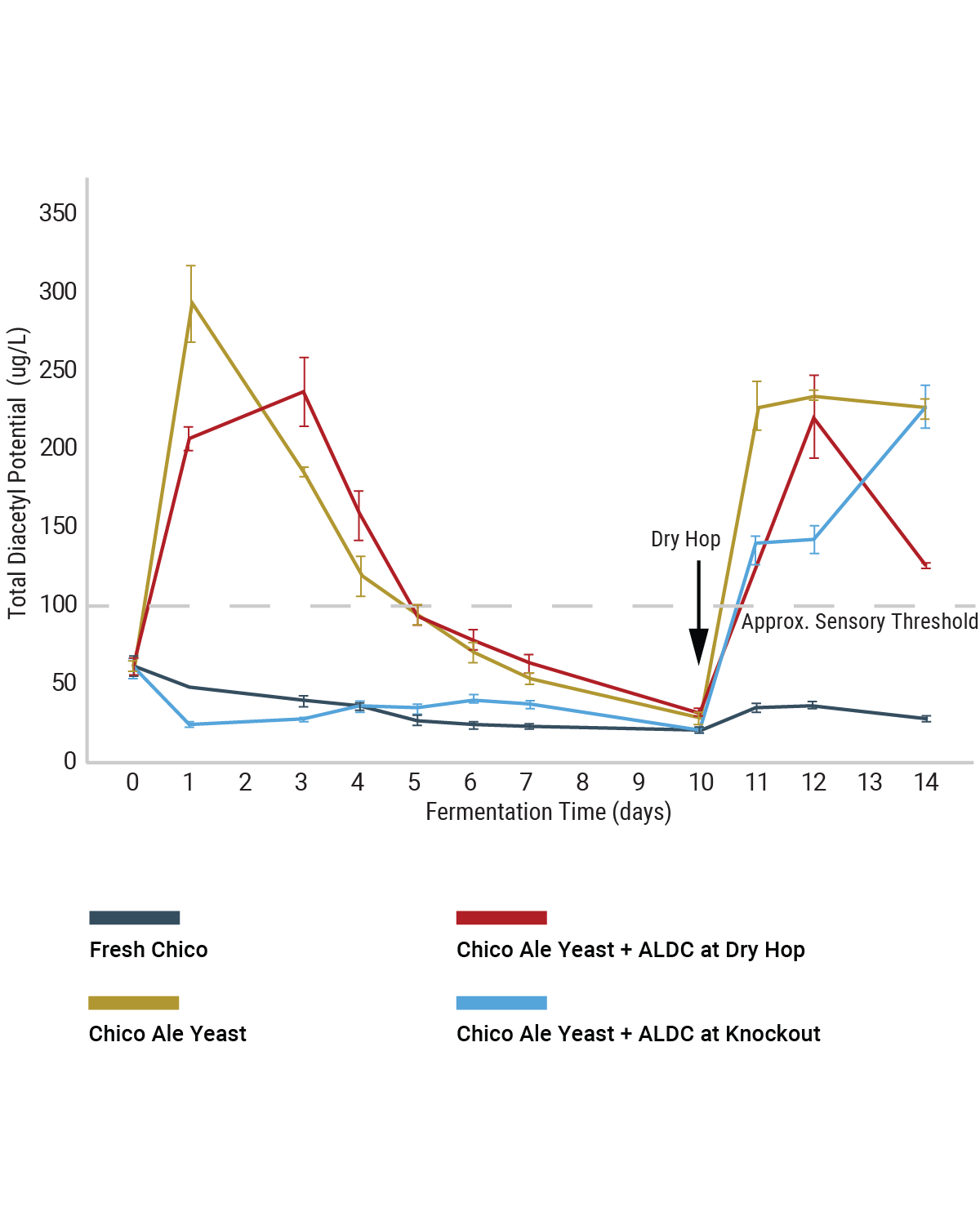
The results were striking: we found that both FRESH™ Chico and purified ALDC effectively reduced diacetyl production during primary fermentation, but only FRESH™ Chico reduced diacetyl production after dry hopping.
Results Breakdown
- Chico yeast without ALDC: As expected, this resulted in a typical diacetyl profile, with diacetyl levels increasing at both the start of fermentation and after dry hopping.
- Chico yeast with ALDC added at knockout: Adding ALDC at knockout reduced diacetyl during primary fermentation, but the ALDC enzyme was less effective during dry hop creep.
- Chico yeast with ALDC added at dry hop: Adding ALDC at dry hop wasn’t effective. Diacetyl still spiked during dry hop creep.
- FRESH™ Chico yeast (with built-in ALDC expression): This strain was the clear winner. It consistently kept diacetyl levels well below the flavor threshold, even as dry hop creep took place, demonstrating the effectiveness of our FRESH™ tech.
So, why is FRESH™ Chico more effective than adding purified ALDC? The simplest explanation is that purified ALDC is much less active at the low pH that is typical after primary fermentation. According to the scientific literature and the manufacturer’s technical data sheet, the optimum pH for ALDC is ~6, and it is substantially less active as the pH decreases. Given that ALDC was effective during primary fermentation (starting pH of ~5) but ineffective during secondary fermentation (pH of ~4.4), we suspect that the low pH of the beer caused the reduction of ALDC activity. In contrast, FRESH™ Chico produces ALDC inside of the cell, which maintains a pH optimum of 6.8, allowing it to function regardless of the external environment.
What this experiment shows is that FRESH™ strains, with their built-in ALDC expression, provide a much more reliable, efficient solution for keeping diacetyl levels low and ensuring clean, hop-forward beers. Like with any good experiment, the results lead to more questions. Stay tuned as we continue to explore these dynamics and refine our understanding of what makes FRESH™ strains such a robust solution for managing diacetyl.
If you haven’t tried FRESH™ strains yet, we invite you to give them a go. We're so confident in their performance that we offer a full refund if you’re not satisfied. Make your beers cleaner, faster, and more consistent with FRESH™.
What brewers say about FRESH™ strains
Kelsey McNair from North Park Beer Co. says, "Just knowing that [ALDC is] built into the yeast is a security blanket."
For brewers like Brian Cendrowski from Fireforge Crafted Beer, it’s a game-changer. “I almost feel like it’s a cheat code," he says. FRESH™ strains simplify the brewing process, cut down on risk, and improve beer quality all at once.
Read more here about the brewers that rely on FRESH™ strains for making award-winning beers.