
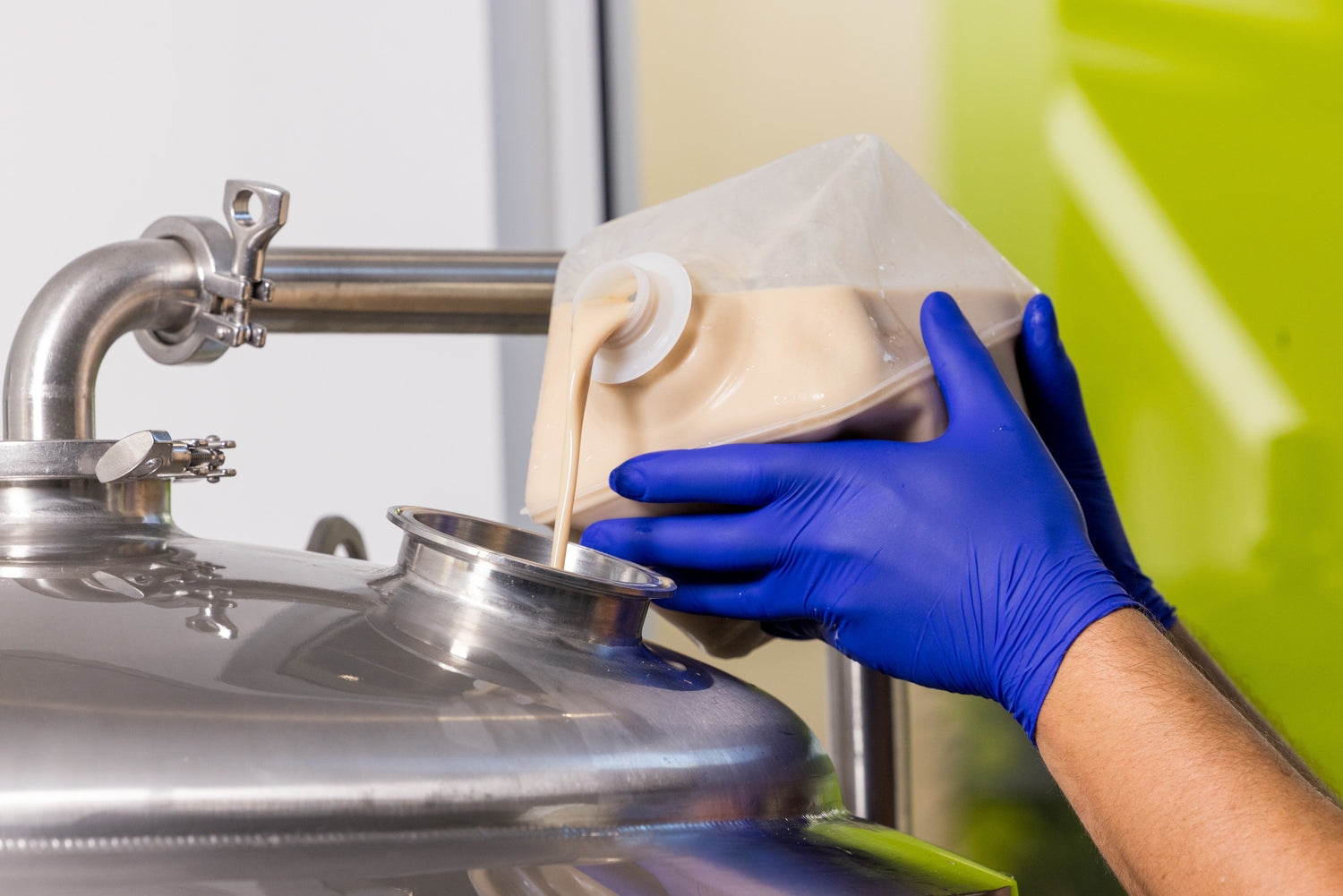
Based on our work with operating breweries, below are our best practices for harvesting our yeast.
1. Ferment
- We recommend harvesting yeast from beers that have a starting Plato of 18 °P or lower. At higher gravities, yeast are put under significant stress that will decline overall yeast health.
- Cool wort and aerate using standard brewery procedures.
- Pitch yeast at a rate of 750K – 1.5M cells/mL/°P (depending on strain).
- Monitor attenuation.
- Dry hopping is detrimental to yeast health. We recommend harvesting yeast before dry hopping.
2. Settle (Two Options)
Option 1: Pressure Method
- Cap the fermentor 1–2 °P before terminal gravity.
- Let pressure increase naturally as the yeast consume the remaining sugar.
- Once the gravity has stabilized, increase the pressure to 8 psi by adding CO₂ through the racking arm (positioned upward).
- Allow the yeast to settle into the cone for 12–24 hours.
Option 2: Soft-Crash Method
- Once fermentation has subsided (3–5 days), set the fermentor temperature to 57–60 °F.
- When the target temperature is reached, add CO₂ through the racking arm to increase the pressure to 8 psi.
- Immediately release the pressure with a quick burst by opening the valve connected to the blow-off. This will help break apart any top-cropping yeast.
- Wait 24 hours for the yeast to settle to the bottom of the cone.
3. Harvest
- To prevent channeling, harvest yeast through a narrow diameter (0.75–1ʺ) sight glass and butterfly valve.
- Verify yeast viability is above 90% before repitching.
- Pitch yeast directly into another tank or store it in a brink for later use. Keep the yeast cold (32–40 °F) if not pitched immediately.
- If using a brink, a sterile filter can be used to allow off-gassing. Yeast will be healthiest if stored below 2 psi.
- When ready to repitch, check viability and calculate the correct amount to match the specs of your next brew.
Cell Counting Tip: London-based strains tend to clump together, making counting difficult. To disperse cells for accurate counts, conduct dilutions in a 0.25 M EDTA solution.